
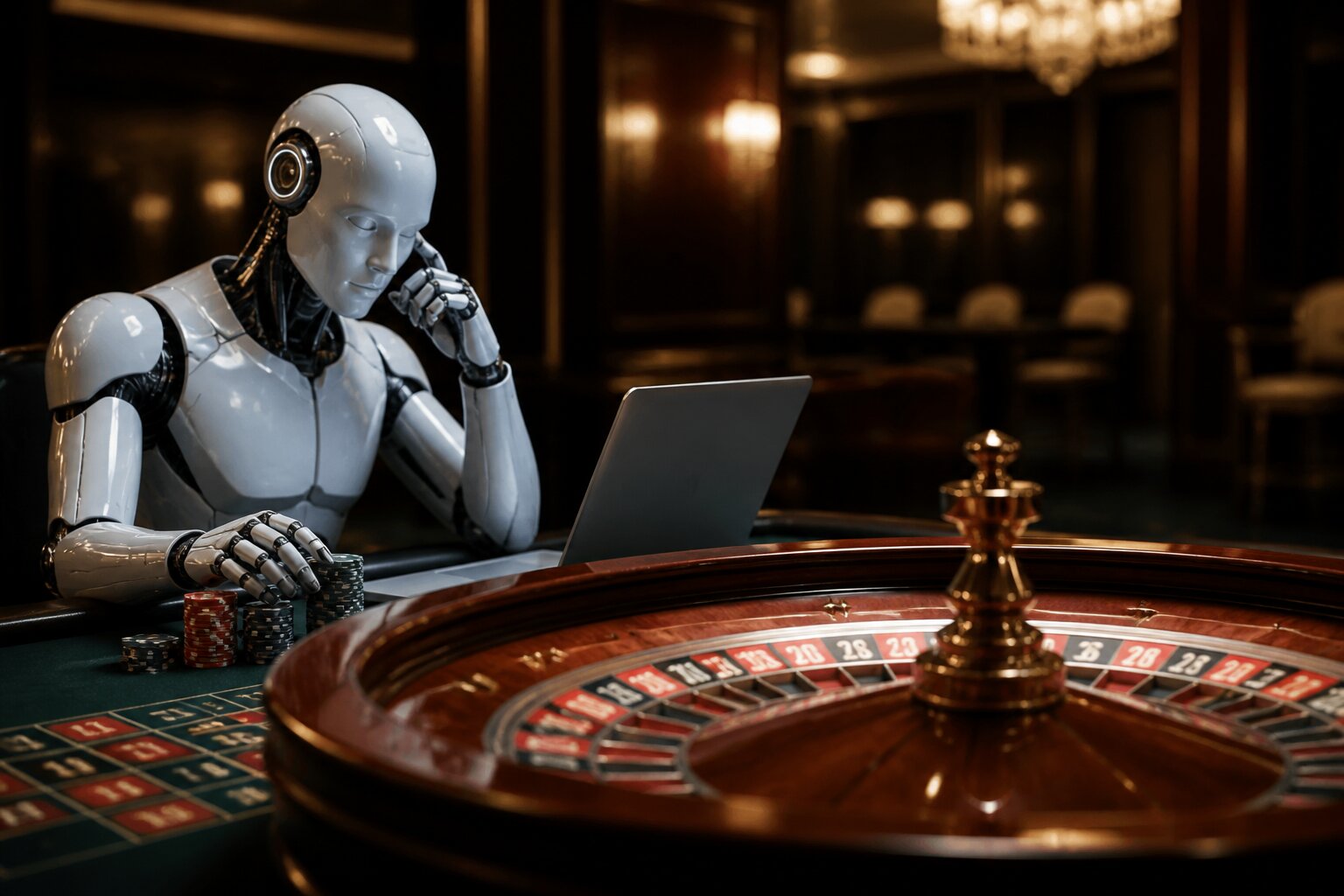
Roulette is one of the most recognisable casino games, with a spinning wheel and a small ball that eventually settles into a numbered pocket. Today, talk of artificial intelligence, machine learning and bots claiming to predict outcomes has captured plenty of attention.
Those claims can be tempting, but there’s a big difference between sensational headlines and what the technology and the rules actually allow. This article looks at the key myths and the real-world evidence so you can tell fact from fiction.
Curious whether technology can really outsmart the wheel? The following sections examine how the game works, how AI is legitimately used in gaming, and why prediction claims don’t hold up.
How Does Roulette Work?
At its simplest, roulette involves a wheel divided into numbered pockets and a ball that comes to rest in one of those pockets after a spin. Players place bets before the spin on single numbers, groups of numbers, colours or other categories such as odd or even. Different bet types carry different payouts: a straight-up number pays more because its chance of occurring is much lower than a red-or-black bet.
In land-based casinos, dealers follow consistent procedures when spinning the wheel and ball to ensure fair play. Online, outcomes are generated by random number generators (RNGs) that undergo independent testing to confirm their integrity. These processes are designed to keep each spin independent and unpredictable.
Regulators require strict fairness and testing, so the odds on a given bet are determined by the wheel layout and the presence of zero pockets. European roulette has 37 pockets, giving a straight-up win probability of 1 in 37, while American roulette has 38 pockets. These mathematical odds are the basis for the house edge and explain why prediction claims face such a fundamental barrier.
Those mathematical limits are important to understand before considering what machine learning can and cannot do in this area. Ahead, we examine how AI is actually applied in the gambling sector.
What Is Machine Learning & How Is It Used in Gaming?
Machine learning is a branch of artificial intelligence that finds patterns in data and refines its output as it sees more examples. In gaming environments, that strength is applied to tasks where pattern recognition adds value without affecting the integrity of outcomes.
A major legitimate use is player protection. Algorithms can flag sudden changes in betting behaviour or unusually long sessions, helping operators offer interventions such as limits or support options. Customer service is another area: chat systems and recommendation engines use machine learning to respond to queries or suggest games a player might enjoy based on their history.
These uses sit squarely within regulatory frameworks that demand fairness, security and consumer safety. Regulators monitor the application of such technology to ensure it protects customers rather than attempting to alter game results. With that context in place, it’s easier to spot where myths about predictive AI begin to diverge from how the technology is actually applied.
Next, we’ll pick apart the most common myths about AI and roulette bots and explain why they don’t stand up to scrutiny.
Common Myths About AI and Roulette Bots
Misinformation about AI and “roulette bots” can create unrealistic expectations and encourage risky behaviour. Below are the key misconceptions that circulate most widely, along with explanations that draw on the technical and regulatory realities of the game.
Myth 1: AI Can Overcome Randomness in Roulette
The idea that AI can penetrate the fundamental randomness of roulette misunderstands both the game and the limits of current technology. Each spin is treated as an independent event; physical wheels and RNG-driven online games are tested to ensure no predictable sequence exists.
Machine learning models require consistent, exploitable patterns to make reliable predictions. Because properly tested roulette outcomes do not contain such patterns, AI cannot consistently forecast where the ball will land. Claims to the contrary ignore the statistical basis of the game and the safeguards operators and regulators maintain to keep it fair.
Myth 2: Roulette Bots Will Always Beat the House
Some products advertise automated systems that supposedly guarantee winnings by placing bets according to complex rules. Such promises are misleading. The house edge is inherent to the game’s design and is not something software can remove. Using unauthorised tools can breach a casino’s terms and result in closed accounts or forfeited funds.
Rather than offering a path to profit, most bot claims rest on selective examples of short-term gains that disappear when examined over larger samples. If a system produced consistent profits it would attract regulatory attention and not remain a secret offered online.
Myth 3: Machine Learning Reveals Predictable Patterns
It’s true that machine learning can detect patterns where they exist, but in a properly regulated roulette environment there are no exploitable patterns in the sequence of winning pockets. Algorithms can track player behaviour and system performance, but they cannot extract a repeatable signal from genuinely random spins.
Assertions that models can use past spins to forecast the next outcome conflict with basic probability: historical results do not influence future independent events. When studies appear to show short-term success, deeper examination usually reveals statistical variance or methodological flaws rather than a genuine predictive capacity.
These myth-busting points set the scene for a closer look at the mathematics and legal constraints that make prediction claims untenable.
Can Algorithms Really Predict Roulette Outcomes?
Looking at the probabilities makes the limits clear. For European roulette, a straight-up bet has a probability of 1/37, roughly 2.7%. In American roulette, with an extra double zero, that probability drops to about 2.63%. Those figures are not affected by prior spins, betting systems or software.
The house edge—around 2.7% for European and about 5.26% for American roulette—ensures the expected return favours the operator over time. Algorithms can process data and optimise certain decisions in contexts where patterns exist, but they cannot change these fixed probabilities or the fact that outcomes are designed to be independent.
Regulatory testing of wheels and RNGs adds another layer of protection. Games are examined to confirm results reflect the theoretical probabilities, and monitoring systems check for irregularities. Given the combination of mathematics and oversight, there is no lawful method by which AI or any algorithm can consistently predict roulette results.
With the mathematical and regulatory obstacles clear, it’s useful to consider the legal and ethical framework that governs attempts to use AI in gambling contexts.
Legal and Ethical Considerations for AI in Casinos
Laws and industry rules make clear that technology cannot be used to gain an unfair advantage in gaming. Regulations require operators to prevent cheating and to prohibit software that attempts to alter game outcomes or enable predictive exploitation. Using unauthorised automation or predictive tools can breach terms and invite account closures, confiscation of winnings and industry-wide bans.
Beyond legal prohibitions, ethical practice emphasises fairness, transparency and consumer protection. Legitimate uses of AI should focus on safety and service: identifying harmful play patterns, delivering helpful information and maintaining secure systems. Attempts to subvert game integrity undermine that framework and carry both legal and reputational consequences for anyone involved.
Understanding these constraints helps explain why operators and regulators respond strongly to claims of predictive tools: the protections in place aim to preserve fair play for all participants.
What Do Real-World Results Show About AI Roulette Bots?
Empirical testing and academic reviews provide a consistent picture: predictive software do not deliver a reliable edge. Peer-reviewed studies and regulator-commissioned reports show that short runs of profit can occur by chance, but that performance regresses to the statistical expectation across larger samples.
For example, evaluations of commercial prediction products and controlled experiments published in academic journals found no evidence of sustained advantage. Media and independent testers who have run lengthy simulations with both physical and online roulette report the same outcome: no consistent outperformance against the expected probabilities.
Those real-world findings reinforce the technical and legal arguments already discussed: when games are properly tested and regulated, predictive software cannot overcome the built-in randomness and house edge. With that in mind, players and operators alike are best served by focusing on safety, transparency and fair play.
This closes the discussion on AI, machine learning and roulette prediction; the evidence and regulation together make clear where the limits lie and why claims of reliable prediction are not supported.
Play Online Casino Games at Cozino
Enjoy a relaxed gaming experience with us at Cozino, where you can unwind and play at your own pace. Our site is here for you whenever you fancy a little entertainment.
Getting started is simple – just create an account, make a deposit and you're ready to play. We look forward to welcoming you and hope you enjoy your time with us.
**The information provided in this blog is intended for educational purposes and should not be construed as betting advice or a guarantee of success. Always gamble responsibly.