
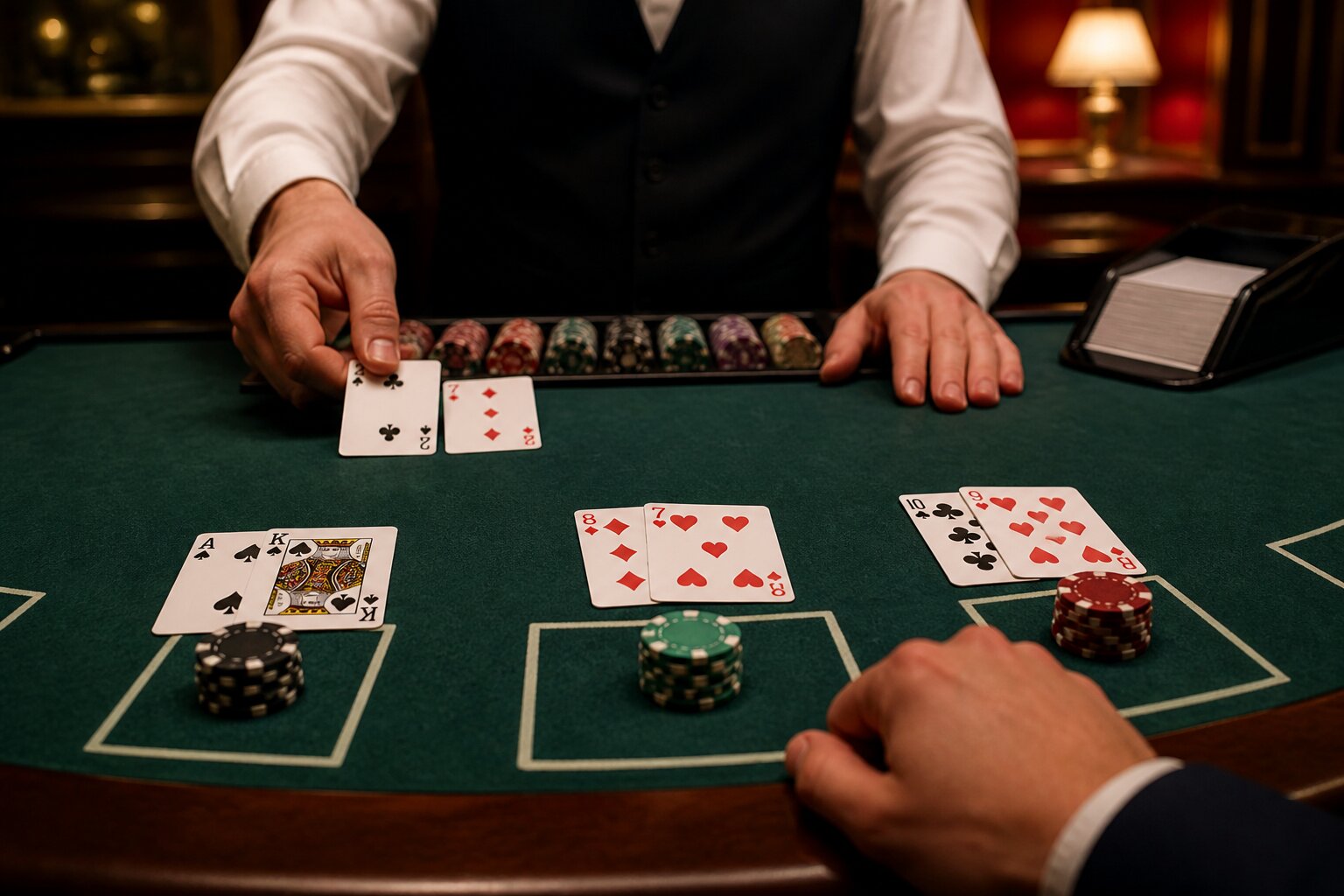
Think you know what the best and worst blackjack hands really are? You might be surprised. From Hollywood films to mate’s tales at the pub, blackjack carries plenty of myths — especially about which hands are winners and which spell disaster.
Before you sit down at the table, it helps to clear up the confusion. This article explores the facts behind popular hand rankings, busts common myths, and explains what genuinely improves your chances at the table.
Whether you play occasionally or more often, understanding hand strengths and the reasons behind good decisions will help you play more confidently and make better choices as the game unfolds.
What Makes a Blackjack Hand “Good” or “Bad”?
A blackjack hand is judged by more than its total value. The main factors are your card total, the dealer’s visible card, and whether you hold a soft or hard hand. These elements combine to shape the likely outcomes and the options open to you.
A soft hand, such as Ace and 7 (soft 18), is valuable because the ace can count as 1 or 11. That flexibility lets you draw another card with less risk of busting, which is particularly useful when the dealer shows a weak upcard like 4, 5, or 6. A hard hand, for example 10 and 7 (hard 17), gives you less room to manoeuvre because the ace’s flexibility is absent. Against a dealer showing a strong upcard such as 10 or ace, even a hard 17 can be at a disadvantage.
Hands under 12 are not always “bad”; they offer potential to improve without immediate fear of busting. Conversely, totals like 16 against a dealer’s 10 are notoriously awkward, as both hitting and standing carry downside. Making the best decision depends on these contextual factors and an understanding of how soft and hard hands change the odds. In the next section, we’ll lay out how hands typically rank in strength.
True Hand Rankings in Blackjack
The strongest possible start is a natural blackjack: an ace plus any 10-value card dealt as the first two cards. This hand wins more often than any other and usually pays a premium on the initial wager, unless the dealer also has a natural, which results in a push.
Other strong hands depend on how likely they are to beat the dealer’s final total. Soft hands that total 19 or 20, such as Ace-8 or Ace-9, win frequently, especially against weak dealer upcards. Hard hands like 20 and 19 are also reliable, but they do not match the special status of a natural blackjack.
Below is a clear listing of typical blackjack hand strengths and approximate win rates. These are averages and will vary with dealer upcards and game rules, but they give a practical sense of relative power.
- Natural Blackjack — Example: Ace + 10/J/Q/K — Typical win rate: around 99% except when the dealer also has a natural
- Soft 20 — Example: Ace + 9 — Typical win rate: about 77%
- Soft 19 — Example: Ace + 8 — Typical win rate: about 67%
- Hard 20 — Example: 10 + Q — Typical win rate: about 75%
- Hard 19 — Example: 10 + 9 — Typical win rate: about 66%
- Hard 17–18 — Example: 10 + 7/8 — Typical win rate: roughly 58–64%
- Hard 16 (vs 10 upcard) — Example: 10 + 6 — Typical win rate: around 23% in that matchup
- Hard 12–15 — Example: 10 + 2–5 — Typical win rate: about 35–43%
These figures reflect average performance. Knowing where your hand sits on this list helps when deciding whether to hit, stand, split or double, which we examine next in relation to common misconceptions.
Common Misconceptions About Blackjack Hands
Many players operate on myths that affect their table decisions. Understanding the reality behind these beliefs prevents costly errors and improves long-term outcomes.
Are all picture cards equally valuable? Numerically, kings, queens and jacks each count as 10, but their value depends on the cards they accompany. Two face cards make a hard 20 — a strong total — while a picture card paired with an ace on the initial deal creates a natural blackjack, which is significantly better.
Does 21 always pay best? Reaching 21 is strong, but there is a distinction between a natural blackjack and a 21 made from three or more cards. A natural typically pays the higher rate on the initial wager, whereas a 21 assembled from multiple cards normally pays at even money. Also, if the dealer matches your 21, the hand pushes, so the payout is not automatic.
Is splitting a pair of eights always a mistake? Many fear breaking a 16 into two hands, but splitting eights is statistically sensible in most situations. A single 16 is a weak standing total; splitting gives two chances to form stronger hands. It is not a guaranteed win, but it commonly improves expected results versus holding the pair.
Understanding these points reduces guesswork at the table and supports more accurate decision-making. The next section looks at hands that carry an inflated reputation and why they are often misjudged.
Most Overrated Blackjack Hands
Some hands look comforting but perform worse than players expect. Recognising these overrated totals helps avoid decisions that feel right but are strategically poor.
Hard 16 is one of the most notorious examples. A combination such as 10 and 6 sits close to 21, but hitting from 16 risks busting and standing often leaves you behind when the dealer completes a strong total. The dilemma this hand creates is why it carries such a poor long-term record.
Hard 12, for example 10 and 2 against a dealer’s 2, is another hand that players misread. Standing feels safe, yet the dealer has a reasonable chance to reach a higher final total; hitting on 12 can be uncomfortable but is frequently the statistically better move.
Even hard 17 can be overrated in certain matchups. While it beats many dealer outcomes, against powerful upcards it struggles to hold up. Seeing which hands are overrated prepares you to handle awkward decisions when they arise. Ahead, we’ll consider the flip side: hands that are undervalued and why they deserve attention.
Most Underrated Blackjack Hands
Some hands are dismissed too quickly, but they offer strategic advantages when used correctly. Spotting these can shift marginal situations in your favour.
Soft hands regularly fall into this group. Soft 18 (ace and 7) often tempts players to stand, yet against a dealer’s strong upcard there can be merit in taking a card because the ace’s flexibility reduces bust risk. Playing soft hands with an eye on the dealer’s card can create opportunities to improve totals without the usual downside.
Low pairs such as 2s or 3s are commonly overlooked. When the dealer shows a weak upcard, splitting these pairs increases the number of favourable outcomes and can produce hands that outpace the dealer more often than sticking with the pair.
An 11 is another frequently underrated holding. With an 11, the potential to reach 21 or a high total with one card makes doubling down a compelling option in many dealer matchups, converting a modest-looking hand into a strong offensive position.
Spotting these underrated hands and selecting the right approach gives practical advantages across many hands. To use that advantage, it helps to understand how soft and hard hands change the game’s dynamics, which is what follows.
How Do “Soft” and “Hard” Hands Affect Outcomes?
The distinction between soft and hard hands is fundamental because it alters risk and decision pathways. A soft hand contains an ace counted as 11, allowing the ace to switch to 1 if a high card would otherwise push the total over 21. This built-in safety valve means soft hands can be played more aggressively without incurring the same bust risk as hard hands.
For example, ace and 6 is soft 17. Drawing a 10 turns that into a hard 17 instead of an immediate bust, which changes the way the hand is evaluated and the remaining options. By contrast, a hard hand such as 10 and 7 (hard 17) lacks that fallback; hitting is riskier because there is no ace to absorb a high card.
This difference explains why strategies for soft and hard hands diverge. Soft totals invite more flexibility and opportunities to improve, while hard totals often force conservative choices to avoid exceeding 21. Recognising which category your hand falls into sharpens judgement and reduces costly hesitation as the round continues.
Final thought: understanding the real strengths and weaknesses of specific hands, and how soft or hard status affects options, helps turn uncertain moments at the table into clearer, more informed decisions.
Play Online Casino Games at Cozino
Ever feel like exploring an exciting new way to unwind online? With our welcoming atmosphere and wide selection, there’s always something to enjoy on our site.
It’s very easy to get involved – just set up your account, make a deposit, and you’re ready to explore everything we have to offer at your own pace. We look forward to seeing you at Cozino!
**The information provided in this blog is intended for educational purposes and should not be construed as betting advice or a guarantee of success. Always gamble responsibly.