
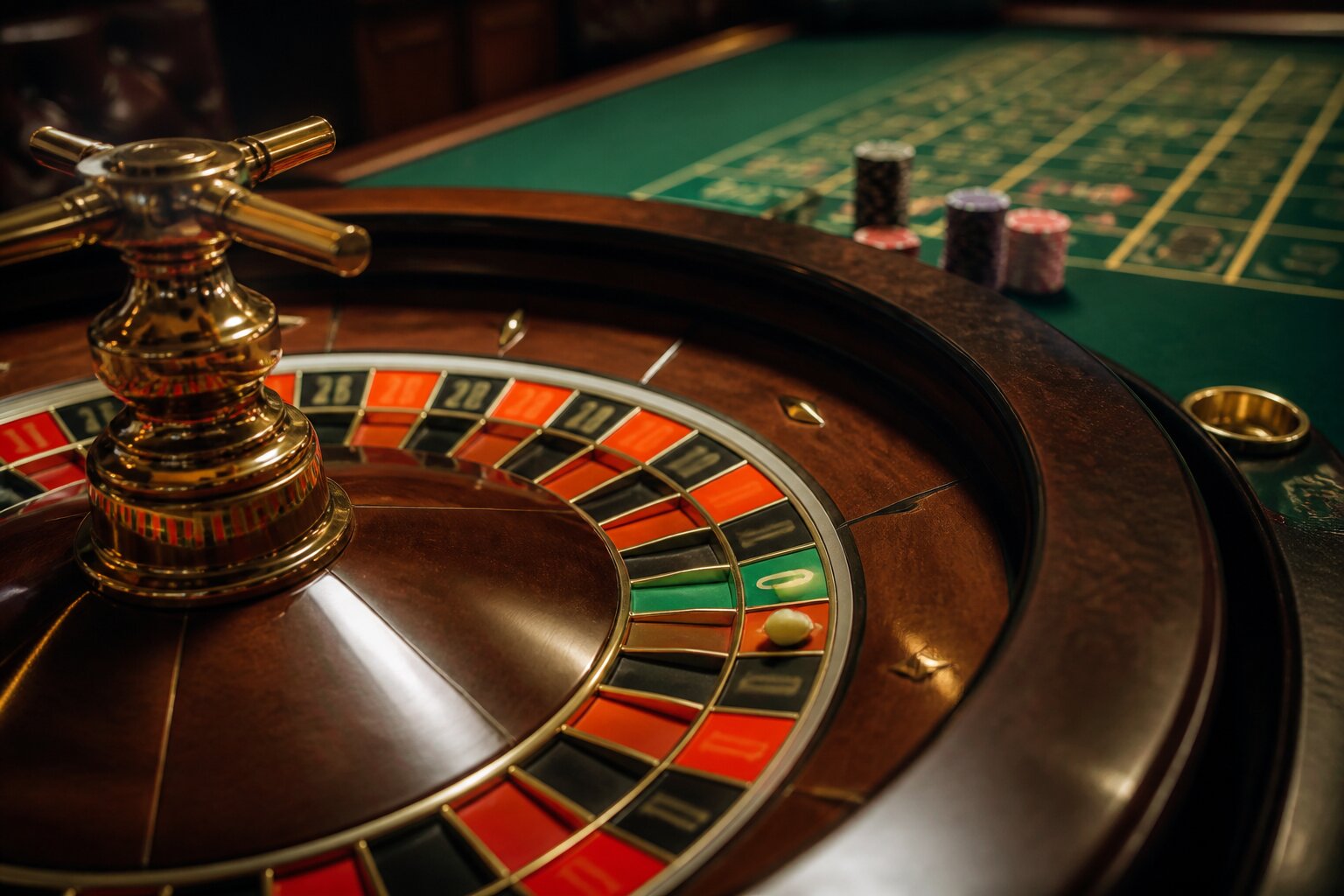
If you’ve ever watched a roulette wheel spin, you might have noticed the green pockets standing apart from the red and black numbers. They carry a different meaning and can influence the result of many common bets.
Knowing what the green spaces represent and what they pay helps make sense of the game and where different bets sit on the risk–reward scale. Read on to learn how green pockets change odds and payouts, and what that means for your choices at the table.
How Do Roulette Payouts Work?
Roulette payouts are determined by the type of bet placed and the version of the wheel in play. Bets covering a single number—known as straight-up bets—offer the highest return, while bets spanning many numbers return less because they are easier to win.
The straight-up payout is 35 to 1. Bets covering two numbers (split) pay 17 to 1; three-number bets (streets) pay 11 to 1; four-number bets (corners) pay 8 to 1; six-number bets (six lines) pay 5 to 1; and column or dozen bets pay 2 to 1. Outside bets such as red/black, odd/even or high/low pay even money, or 1 to 1, because they cover roughly half the wheel.
These payout levels reflect mathematical probabilities built into the wheel’s layout. It’s sensible to keep stakes within personal limits and be aware that over many spins the game’s design determines long-term returns. Next, we’ll look at the green pockets themselves and why they matter to those probabilities.
Green Numbers on a Roulette Wheel: What Do They Represent?
Green pockets are the non-coloured markers on the wheel that are labelled zero on European and French wheels, and zero plus double zero on American wheels. All other numbers are split between red and black; the greens stand apart and behave differently in terms of which bets they affect.
Their practical effect is simple: when the ball lands on a green pocket, outside bets—red/black, odd/even, high/low—do not win, because those outcomes do not apply to the green slots. That single rule is what gives the casino its statistical edge, since those commonly played outside bets otherwise cover about half the wheel.
On a European wheel there are 37 pockets (numbers 1–36 plus a single zero), while an American wheel has 38 pockets thanks to the extra double zero. Because the greens change which bets win or lose, they are central to understanding how odds and payouts are calculated. The next section explains what a straight-up bet on green actually pays.
What Is the Value of a Green Bet in Roulette?
A bet placed directly on a green pocket—zero in European or French roulette, and zero or double zero in American roulette—is treated like any other straight-up number bet and pays 35 to 1. That payout applies uniformly to any single number hit on the wheel.
For example, a £1 straight-up win returns £35 in winnings plus the original £1 stake for a total of £36. A £5 successful straight-up bet returns £175 plus the £5 stake, totalling £180. The payout rate is the same regardless of which single pocket is hit, but the probability of that outcome differs between game versions because of the number of pockets.
Because those probabilities are low compared with many other bets, the 35 to 1 payout is considerably larger. Keep your wagers proportionate to what you can afford, and consider the odds in the following section to see how often such wins can be expected.
What Are the Odds of Hitting a Green Pocket?
The chance of a straight-up green hit depends on the wheel type. In European and French roulette there are 37 pockets, so the chance of any single specified pocket—such as zero—is 1 in 37, or about 2.70%. On an American wheel with 38 pockets, the chance for a specific pocket like zero or double zero is 1 in 38, roughly 2.63%.
If a player places separate straight-up bets on both green numbers in American roulette, the combined chance that the ball lands on either green pocket is 2 in 38, or about 5.26%, though each individual straight-up still qualifies for the 35 to 1 payout only if that specific number wins. These percentages show why straight-up green bets have high returns but occur relatively infrequently. To compare those probabilities with other bets, the next section lays out how green payouts sit alongside more common wager types.
Green Payouts Compared to Other Roulette Bets
Below is a clear comparison of common roulette bets on a European wheel, showing typical payout ratios and approximate probabilities.
Bet Type — Payout Ratio — Probability (Approx.)
- Green (0) — 35 to 1 — 2.70%
- Red or Black — 1 to 1 — 48.65%
- Odd or Even — 1 to 1 — 48.65%
- High or Low — 1 to 1 — 48.65%
- Dozens — 2 to 1 — 32.43%
- Columns — 2 to 1 — 32.43%
- Six Line — 5 to 1 — 16.22%
- Corner — 8 to 1 — 10.81%
- Street — 11 to 1 — 8.11%
- Split — 17 to 1 — 5.41%
- Straight-Up (any number) — 35 to 1 — 2.70%
This shows the trade-off between likelihood and return: outside bets win much more frequently but pay much less, while straight-up green bets pay well but are rare events. With that in mind, the final section examines how the wheel variant changes these relationships in practice.
Understanding European vs American Roulette Green Values
The single practical difference between European and American roulette is the number of green pockets: one zero in European and French games, two green pockets (zero and double zero) in American games. That extra pocket in American roulette both lowers the probability of any single number coming up and increases the house edge.
Because payouts for a straight-up number remain 35 to 1 in both versions, the extra pocket in American roulette creates a larger gap between the true odds and the payout, which increases the house advantage to about 5.26%. In contrast, the single-zero European wheel gives a house edge of about 2.7%. For those choosing between games, that difference affects expected returns over many spins.
Whether a player prefers the slightly better mathematical odds of the single-zero wheel or the traditional layout of the American wheel is a matter of personal taste. Either way, understanding how the green pockets influence probabilities and payouts helps set realistic expectations and informs betting choices.
All things considered, the green pockets are a small but fundamental part of roulette’s structure: they change which bets win, alter the odds for single-number wagers, and determine the difference in house edge between wheel types. Keep those factors in mind when deciding where and how to place bets, and always play within your limits.
Enjoy Casino Games at Cozino
We’re delighted to welcome you to our site, where you can have a relaxed and enjoyable experience with our range of casino games. Whether you’re a seasoned player or just exploring, our friendly atmosphere helps everyone feel at home.
**The information provided in this blog is intended for educational purposes and should not be construed as betting advice or a guarantee of success. Always gamble responsibly.