
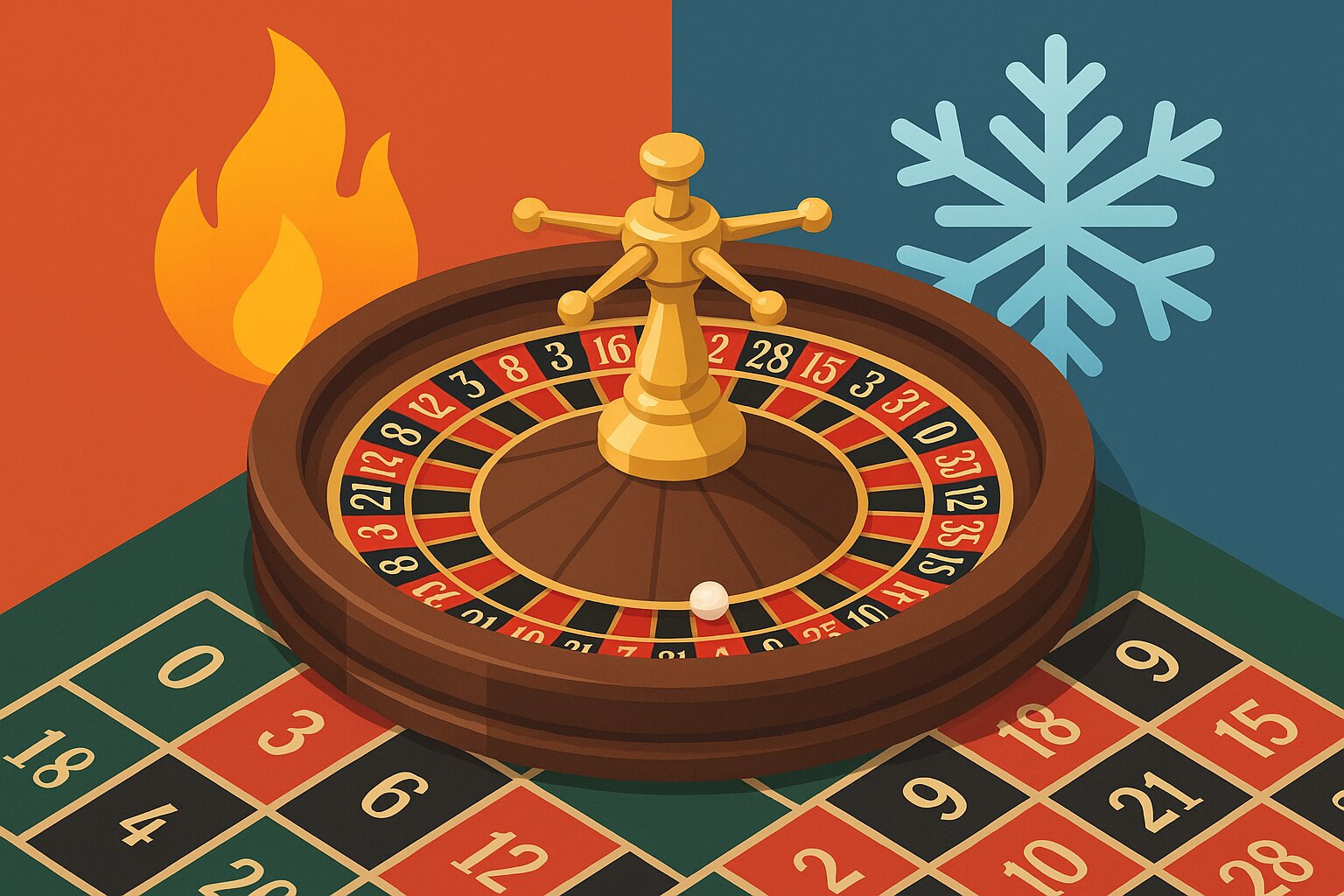
Ever wondered why some numbers seem to pop up more often than others at the roulette wheel? Players often talk about "hot" and "cold" numbers, and those conversations can spark curiosity about whether the patterns mean anything useful.
This post explains what hot and cold numbers are, how they are tracked, and how players typically use that information. It sticks to facts and general information rather than offering advice or predictions.
If you want clear examples and a practical view of whether these patterns should affect your choices at the table, read on — the next sections lay it out step by step.
What Are Hot Numbers and Cold Numbers in Roulette?
Hot numbers are simply those that have appeared more often than others within a recent sample of spins. Cold numbers are the opposite: numbers that have appeared less frequently or not at all in the same timeframe.
These labels are descriptive, not predictive. They record what has already happened over a set of spins, such as the last 20, 50, or 100. Each spin that follows starts from the same set of probabilities, so a number being hot or cold does not alter its chance on the next spin.
People track hot and cold numbers because it adds an extra layer of interest while watching the game, but the label itself does not change the mechanics of how the roulette wheel or the online games or the random number generator operates.
How Are Hot and Cold Numbers Determined?
Identifying hot and cold numbers is a matter of counting outcomes over a defined recent period. Some players and casinos use short windows like 20 spins for a quick snapshot, while others monitor longer runs such as 50 or 100 spins to see broader patterns.
Online interfaces often update these counts automatically after each spin using basic tracking software. In live casinos, digital boards or manual scorekeeping serve the same purpose. The criteria for what counts as "hot" or "cold" can vary, because there is no standardised threshold — one operator might highlight the top five most frequent numbers, another might show those that have not appeared for the longest stretch.
These displays are retrospective summaries. They reflect recent history rather than forecast future results.
Are Hot & Cold Numbers Reliable Indicators in Roulette?
Many players hope that trends will suggest what will happen next, but there is no evidence that hot or cold numbers reliably indicate future outcomes. Modern roulette systems, whether physical wheels maintained to strict standards or online games using certified random number generators, aim to produce fair and independent results.
Probability governs the chances for each number on every spin. Short runs where certain numbers repeat or vanish are expected in random sequences and do not imply that the wheel has a memory or a bias that will affect subsequent spins.
With that in mind, watching hot and cold numbers is best treated as a way to follow the game’s unfolding story, not as a source of predictive power.
The Role of Probability in Hot and Cold Numbers
Probability explains why hot and cold runs appear. When many independent events occur — in this case, spins — clusters and gaps will emerge just by chance. Statistics describe how likely different patterns are to occur over various sample sizes, and over the long run the frequency of each number will tend to move toward its theoretical expectation.
Short-term variation is normal. That is why a number can seem hot over 20 spins and not stand out over 200. Understanding this helps set realistic expectations about what hot and cold lists represent.
Common Myths About Hot & Cold Numbers in Roulette
A persistent myth is that a number that has not come up for a while is "due" to appear. Another is that betting on numbers shown as hot will boost your chances. Both ideas misinterpret randomness.
Because each spin is independent, past sequences do not cause future ones. Treating hot and cold lists as signals to change betting behaviour can lead to unrealistic expectations and decisions based on patterns that have no causal effect.
Viewing these lists with a critical eye prevents misunderstanding. If you enjoy following trends, keep it as part of the experience rather than a strategy for predicting results.
How Do Casinos Display Hot and Cold Numbers?
Casinos present hot and cold data in ways that are clear and easy to follow. Online, you will often see a panel that updates after each spin, listing numbers that have appeared most or least frequently in the chosen window. In physical venues, screens or boards near the table show recent winning numbers along with any highlighted hot or cold entries.
The presentation varies by operator: some offer configurable history lengths, others show only a brief recent run. Whatever the format, these displays are summaries of prior outcomes intended to inform or entertain players, not to change the underlying probabilities.
If you like monitoring trends, it is worth checking how a particular game or site defines its hot and cold metrics so you know what the display is actually telling you.
Practical Examples of Hot and Cold Numbers in Action
Imagine you are watching a game and the number 17 appears three times within the last 20 spins. A hot-number display might flag 17 because it ranks among the most frequent in that short window. Conversely, if 26 has not shown up in 50 spins, it will appear as a cold number on many interfaces.
These examples show the mechanics behind the labels: they reflect short-term frequency. Depending on how long you track results, the same number may move between hot, neutral, and cold statuses. This ebb and flow illustrates why these lists are snapshots rather than statements about what will happen next.
Paying attention to the sample size behind any display helps interpret what the highlighted numbers actually mean.
Should You Use Hot & Cold Numbers for Your Roulette Game?
Whether to consult hot and cold indicators comes down to personal preference. Some players enjoy incorporating the information into their observations, while others prefer to ignore it completely. Either approach is valid, provided expectations remain realistic.
These indicators do not change the mathematical odds for any spin. If you find watching trends adds interest and keeps the experience engaging, it can be part of how you follow a session. If you think such patterns might encourage poor decisions, it is better to ignore them.
Wherever you stand, a sensible approach keeps play within set limits and treats roulette as entertainment. If you want to explore games or see live tracking in action, you can browse our roulette tables to find formats and displays that suit your preference.
This wraps up the essentials on hot and cold numbers: they describe recent results, offer a way to follow the game, and should not be taken as predictors of future spins.
**The information provided in this blog is intended for educational purposes and should not be construed as betting advice or a guarantee of success. Always gamble responsibly.