
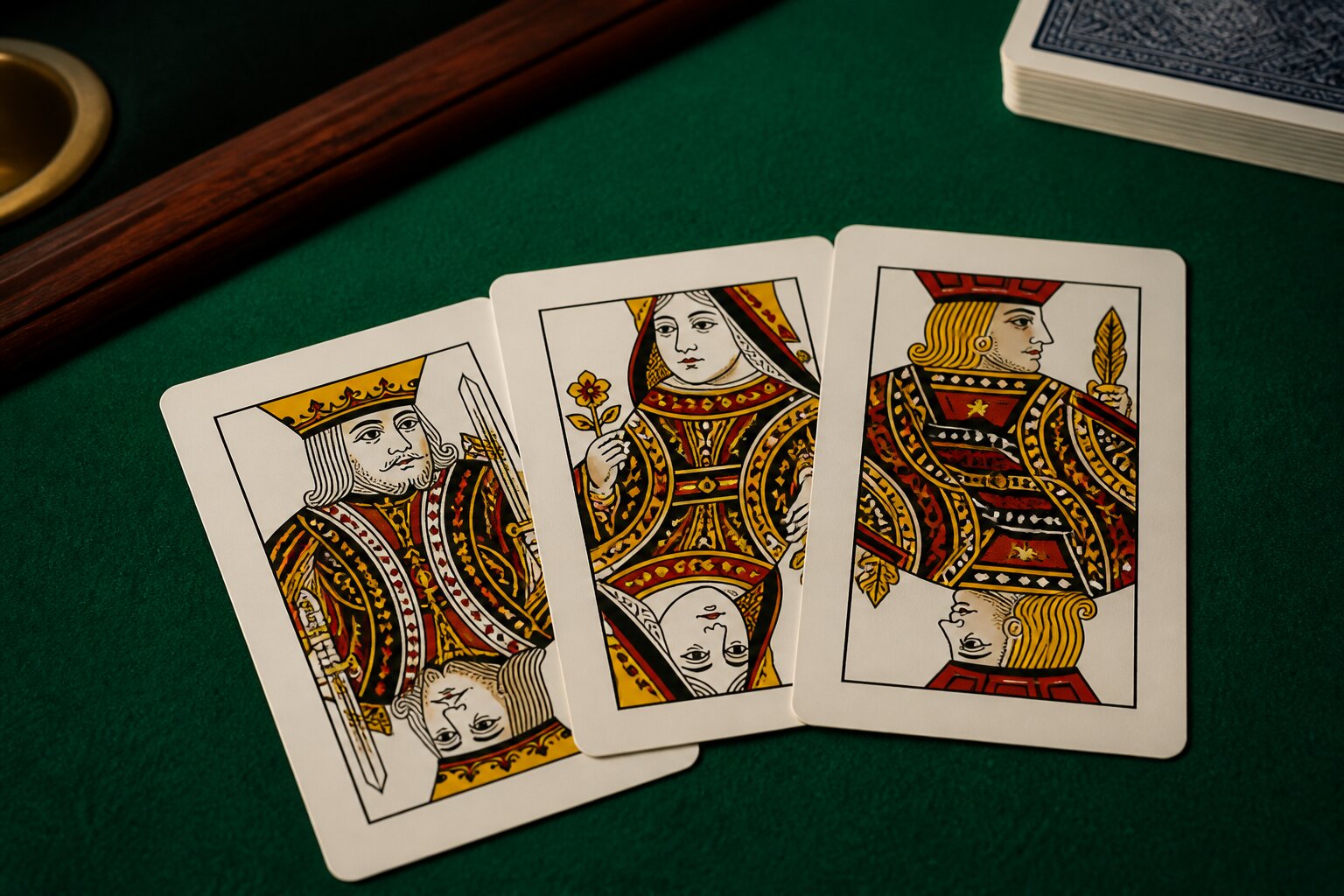
Ever wondered why some playing cards stand out with detailed illustrations and regal faces? If you’ve heard the term “face cards” and aren’t exactly sure what it means, you’re not alone.
Whether you play casually at home or just like examining a deck, understanding face cards adds a new layer to the cards you already know. Read on to learn what these cards are, how they differ, and why they keep turning up in games and culture.
What Is a Face Card in a Deck of Cards?
A “face card” is any card in a standard deck that shows a person’s portrait on its front. In each of the four suits—hearts, diamonds, clubs and spades—you’ll find three such cards: the Jack, the Queen and the King. That gives a total of 12 face cards in a 52-card deck.
These picture cards are designed to be instantly recognisable. Their portraits, attire and often mirrored layouts distinguish them from the numbered cards and the Ace, so players can identify them quickly during play.
To keep play fair and enjoyable, it’s sensible to set limits and stick to them when games involve stakes. Treat games as entertainment rather than a way to solve problems.
The Different Types of Face Cards Explained
Here’s a closer look at each face card you’ll find in a typical deck and how they’re usually presented.
Jack
The Jack, historically also known as the knave, is typically shown as a younger male figure. In many decks the Jack’s portrait is full of small details, which hint at a courtly or military role. Common decorative elements include:
- plumed hats
- capes
- weaponry such as spears or daggers
Jacks are often depicted in a profile or three-quarter view. Because many designs are mirrored, the image reads the same when the card is turned, which helps keep the portrait recognisable during play.
Designers sometimes use Jacks to convey a particular mood or narrative, so you may find variations that reflect historical uniforms, modern fashion or purely decorative motifs.
Queen
The Queen is shown as a female royal. Her attire, crown and the objects she may be holding vary by design and era, but she generally carries symbols of refinement or authority. Typical motifs can include a flower, a book, a fan or a small sceptre, each suggesting different attributes such as grace, wisdom or leadership.
Some historical decks link each Queen to a historical or mythological figure, which explains why different decks present distinct costumes and motifs. Queens are usually printed with mirrored images as well, making them easy to read from either orientation.
Because Queens often represent qualities rather than specific individuals, artists have a lot of freedom to reinterpret them across different cultural and artistic styles.
King
The King is the most senior of the three face cards in traditional rank. His beard, robes and sceptre or sword mark him as a ruler and signal authority at a glance. Kings are usually printed with a mirrored design so the figure appears upright whichever way the card is held.
Across decks, artistic styles range from very plain and geometric to richly detailed and ornamental. Some Kings are sober and austere, while others are highly decorative and full of symbolic imagery.
The King often serves as the visual anchor of a court card set, and small changes in facial expression, posture or regalia can give a deck a very different character.
Although these descriptions cover common features, note that designers sometimes adapt portraits for artistic or cultural reasons. That variety is part of what makes different decks interesting to collect.
Design choices can reflect historical periods, regional traditions or contemporary trends, so two decks of the same nominal design may still look quite different.
Why Are Face Cards Called ‘Face’ Cards?
The name comes from the obvious reason: these cards show faces. Unlike number cards that display pips, the Jack, Queen and King carry human portraits. Early card makers used these illustrated designs to mark high-ranking or special cards in the pack, and the simple term "face card" has stuck ever since.
The term highlights a visual distinction rather than any hidden symbolic meaning. In many games you will treat face cards differently because of their picture and their role rather than because of any extra lore attached to them.
You may also hear them called "court cards" in some places, reflecting the idea that they represent members of a royal court. Different cultures and card makers have altered the styles and names over time, but the essential idea is the same: these are the cards that depict people rather than numbers.
In practical play, face cards often carry specific values or effects depending on the game. For example, some games assign them a value of 10, while in others they have unique powers or are simply higher ranked than numbered cards. Their recognisable faces make them easy to spot during play, which is one reason the illustrated designs endure.
What Do the Face Card Symbols Represent?
Each face card belongs to one of the four suits—hearts, diamonds, clubs and spades—and those suit symbols help group the face cards and set their roles in play.
Historically, people have attached meanings to the suits: hearts with emotion, diamonds with material matters, clubs with growth or work, and spades with authority or conflict. Those associations come from older systems of symbolism rather than from modern gameplay, so they’re useful for understanding historical decks or artistic choices, but they don’t determine a card’s function in most games.
The portraits themselves were originally intended to represent ranks within a courtly hierarchy: knaves or servants, queens and kings. Over time, designers added individual touches—specific crowns, weapons or flowers—that make each face card visually distinct and easier for players to recognise.
How Many Face Cards Are in a Standard Deck?
A standard 52-card deck contains 12 face cards. There are three face cards in each suit, and four suits in total, which gives a total of 3 multiplied by 4 equals 12. These are a fixed feature of traditional decks used for most common card games.
The three face cards in each suit are:
- King
- Queen
- Jack
In some older texts the jack may be called the knave, but it serves the same role in the pack. Jokers are not counted as face cards in a standard deck, since they are usually treated as separate wild or special cards.
This count holds true whether you pick up a modern deck or an older-style pack, although specialty decks and some children's packs may change the composition for a particular game. If you are using a pared-down deck for a specific variation, the set of face cards included will depend on that game's rules.
Do All Card Games Use Face Cards?
Not every card game uses every card in the deck. Many familiar games, such as Poker and Rummy, include the full range of cards, so Jacks, Queens and Kings are part of play. Other games select a subset of the deck: certain forms of Euchre or some traditional regional games use only a specific run of cards, and some family or children’s games deliberately remove face cards to simplify play.
When a game omits face cards, it usually does so to change the balance or to make ranks and strategy clearer for players. Whether a face card matters in a given game depends on the rules and objectives rather than on any intrinsic property of the card itself.
Common Myths & Misconceptions About Face Cards
A number of myths have grown up around face cards, but most are rooted in folklore or misunderstanding rather than fact. One widespread idea is that the portraits carry hidden meanings or secret powers; in truth, they are decorative and practical, intended to mark rank and make identification easier.
Another misconception is that face cards always outrank number cards. While that’s true in many games, it’s not universal—some games rank the Ace higher than the King, others treat Aces as low, and some use special rules that change the usual order. Artwork also does not affect how cards shuffle or are dealt: production standards apply equally across the pack.
Being aware of these myths helps you read the deck with a clearer sense of history and design, without assuming any mystical significance.
Face Cards in Popular Culture
Face cards appear frequently outside the card table, used by storytellers and visual artists to convey status, conflict or intrigue.
In film and television they are visual shorthand: a close-up of a King or Queen can hint at power struggles, character motivations or the stakes in a scene, and designers often use specific faces to suggest a theme without words.
In literature and art, face cards sometimes serve as metaphors for identity, hierarchy or deception. Classic examples include the Queen of Hearts in Alice’s Adventures in Wonderland, where a card’s imagery is woven into character and plot. Artists also use face card motifs in prints and installations to comment on society’s structures or to play with iconography.
These cultural uses show how a simple set of portraits has been repurposed to carry meaning beyond games, while still remaining grounded in the straightforward functions of a deck.
These are the basics and some deeper notes on the face cards you see every time you open a pack. If you want to explore how specific games treat these cards or how different historical decks portrayed them, there’s plenty more to discover within the same familiar faces.
**The information provided in this blog is intended for educational purposes and should not be construed as betting advice or a guarantee of success. Always gamble responsibly.