
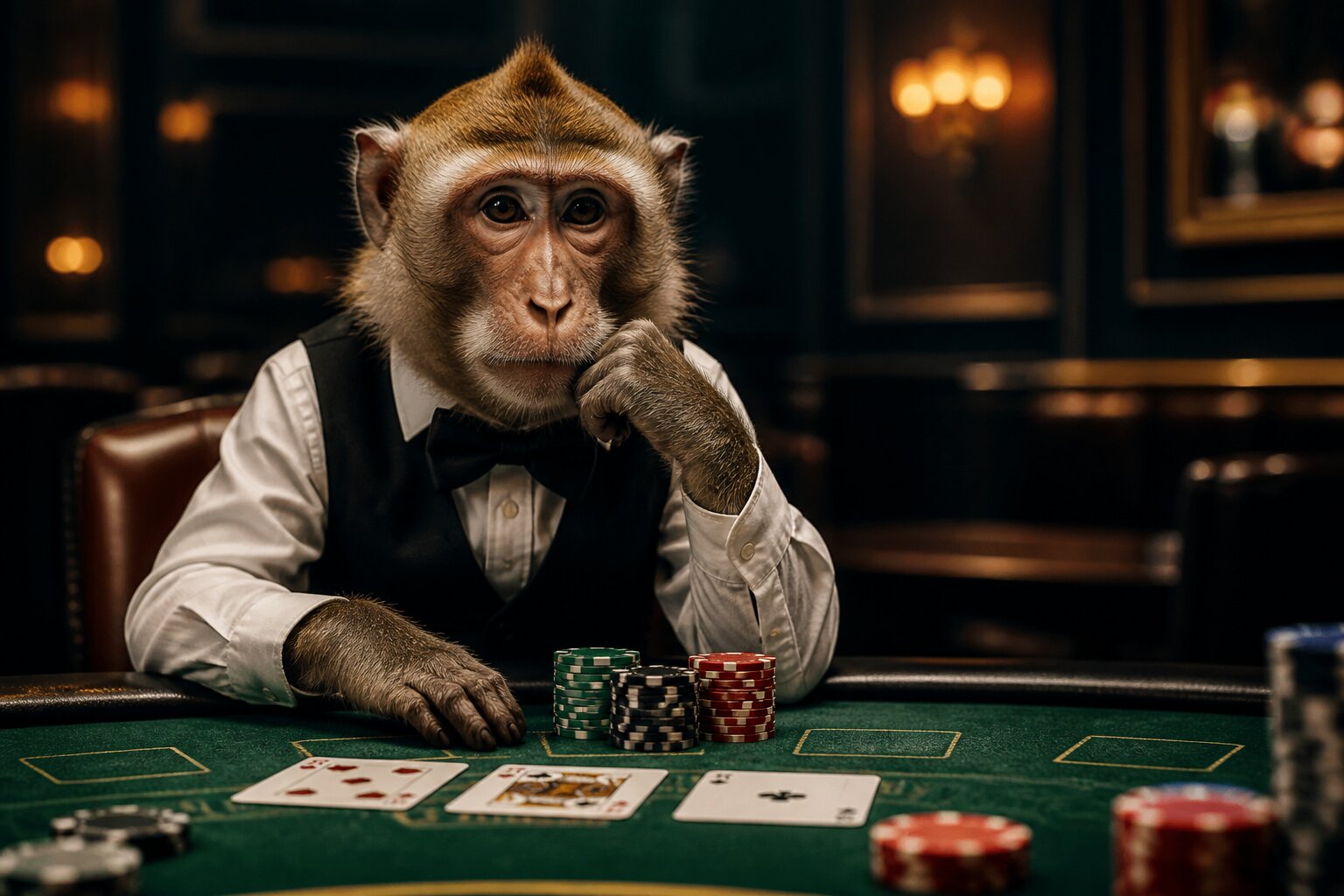
Ever heard the word “monkey” shouted across a blackjack table and wondered what it means? Casino slang can be confusing, especially if you’re new to the game or watching your mates play for the first time.
These quirky terms are part of the atmosphere that surrounds blackjack, adding colour to the play without changing the rules. Read on to learn exactly what “monkey” means, where it might have come from and how players use it at the table.
What Does "Monkey" Mean in Blackjack?
In blackjack, "monkey" is a nickname for any card worth ten points. That includes the numerical 10 and all face cards: Jack, Queen and King. Each of those cards counts as ten toward a player’s hand total.
Players sometimes call out "monkey" when they hope the next card will be a ten-value card, for example when a hand of 11 would be improved by a ten. Saying it is part of the table banter; it does not affect the dealing process or the mathematical chance of drawing a ten-value card.
To be exact, "monkey" refers to:
- The 10 of any suit
- The Jack, Queen and King of any suit
This little bit of slang makes the game feel livelier and gives players a shorthand for the card value they want. Next, we’ll look at how that playful nickname might have entered casino parlance.
Origins of the "Monkey" Term in Casino Slang
The true origin of "monkey" in card games isn’t definitively recorded, but several plausible explanations exist. One possibility is that the term travelled from Asian gambling cultures, where similar nicknames for face cards appear in games like baccarat. As players and dealers moved between regions, the phrase could have transferred into blackjack and other card games.
Another idea links the term to informal British slang, which sometimes uses animal nicknames in colourful ways; though this connection is less direct, it would explain how an expressive word came to label ten-value cards. A third, more intuitive suggestion is that the lively image of a monkey matches the dramatic effect a ten can have on a hand, suddenly changing the play.
Whichever theory is closest to the truth, the term stuck because it’s short, memorable and captures a key moment in play. Knowing the likely background helps when you hear it at a table, and next we’ll consider why players keep using the word.
Why Do Players Use the Word "Monkey"?
Players use "monkey" mainly to add excitement and shared feeling at the table. Calling for a "monkey" is a quick way to express a hope for a ten-value card, and it becomes part of the social fabric of the game—something dealers and other players recognise and sometimes join in with.
This sort of table talk doesn’t change the cards being dealt; it’s a social signal rather than an influence on the outcome. It can build camaraderie—someone doubling down on 11 may call for a "monkey" and others might echo that cheer—while still keeping the focus on fair play and proper etiquette.
Keep the atmosphere friendly and avoid disruptive reactions: a smile or a polite nod is enough if you don’t want to join in. With that social backdrop understood, it’s interesting to see how usage varies around the world.
Famous Regional Variations and Usage
Slang at casino tables changes with culture and language, so "monkey" is just one of several terms players use for ten-value cards. In some English-speaking venues it is common, while other regions prefer different words or none at all. The choice of term often depends on local tradition, the dominant language at the table and the type of game being played.
"Monkey" in Asian Casinos
In parts of Asia, the term is especially common and can be heard not only in blackjack but in baccarat and similar card games. There, the chant for a "monkey" often becomes a group expression, with several players reacting at once when a ten-value card is possible.
This collective response can form part of the atmosphere around a table, and the call is often made with lively or rhythmic intonation. While it can add to the social side of play, the use of slang tends to vary from one casino to another, and newcomers may find it helpful to listen first before joining in.
Common Alternatives and Related Slang
Other expressions used elsewhere include "paint" for picture cards, "face card" as a straightforward label, "picture card" in more traditional settings, and "ten spot" as an informal call for a ten-value card. These variations reflect local tastes in table talk and can make each casino feel a little different.
Understanding these alternatives helps when you travel or play with a mixed group, and it sets the scene for how to behave when someone calls out a slang term at your table. Paying attention to the tone and context will usually make it clear whether a phrase is simply part of the banter or something you should ignore.
How to Respond When You Hear "Monkey" at the Table
When someone says "monkey" at a blackjack table, the simplest response is to keep things pleasant and respectful. Joining in quietly is fine if the table atmosphere allows it, but staying focused on your own play is equally acceptable.
Avoid negative reactions or distracting comments; good manners maintain a better experience for everyone. If you’re unsure about a house rule or the table’s etiquette, a short polite question to the dealer clears that up without interrupting the flow of the game.
Remember to manage your betting to match your own limits and priorities, and to treat the game as entertainment rather than a source of stress. That keeps the session enjoyable for you and those around you.
Above all, a friendly approach to table talk and an awareness of local slang help you fit right in and enjoy the game from the first hand.
Enjoy Casino Games at Cozino
We’re always delighted to welcome you to our site, where you can discover a friendly and relaxed atmosphere to enjoy casino games your way. Settle in and make the most of an entertainment experience shaped with you in mind.
Getting started is easy—simply set up your account, make a deposit, and you’re all set to explore what we have to offer. We hope you enjoy your time with us at Cozino.
**The information provided in this blog is intended for educational purposes and should not be construed as betting advice or a guarantee of success. Always gamble responsibly.